Experts gather in Bali to discuss AIDS fight

Monday, August 10, 2009


A clinic where patients receive medical treatment for HIV/AIDS in Jakarta. Experts from 65 nations gathered in Indonesia to assess progress in the battle against HIV/AIDS in Asia and the Pacific, amid concern that only a quarter of those in need in the region were getting treatment.
(AFP/File/Adek Berry)


Sun Aug 9
NUSA DUA, Indonesia (AFP) – Experts from 65 nations gathered in Indonesia Sunday to assess progress in the battle against HIV/AIDS in Asia and the Pacific, amid concern that only a quarter of those in need in the region were getting treatment.

The ninth International Congress on AIDS in Asia and the Pacific (ICAAP), to be opened by Indonesia's President Susilo Bambang Yudhoyono on the resort island of Bali, will look at how to ensure "universal access" to antiretroviral treatment, congress chairman Zubairi Djoerban said.

He said that only 25 percent of the 1.7 million of people with HIV/AIDS in the Asia-Pacific region who needed the treatment were receiving it.

"We're still far away from our target," he said.

"We're not talking 100 percent, which is the ideal. If Latin America can treat 62 percent of sufferers there, we should strive towards that."

UNAIDS regional director Prasada Rao said that countries such as Thailand, Cambodia and Laos have been able to treat 80 percent of HIV-positive people there but about 10 countries managed to cover only 10 to 15 percent, due to geographical limitations and lack of funding.

An estimated five million Asians are living with HIV, especially in southeastern countries such as Thailand, Cambodia, the Philippines and Indonesia, according to a UN report released last year.

The congress, which runs until Thursday, will also demand commitment from governments to tackle a disease that killed 380,000 people across Asia in 2007, Djoerban said.

"We ask for commitment from the countries to achieve the targets they have set and if they say they can't, we'll discuss new efforts to help them reach their goals," he added.

"We can discuss prevention and treatment but with no leadership and commitment from countries and the community, we won't achieve much."

The congress also aims to put pressure on governments to change policies that "just keep on discriminating people because of their sexual behaviour such as males who have sex with males and commercial sex workers," Rao told reporters.

While there are some bright spots in the region, such as Cambodia, where HIV prevalence has declined through condom use, new infections are growing in populous countries such as Bangladesh and China, the UN report said.

In Indonesia and South Asia, Djoerban said, the biggest threat was the lethal combination of dirty needles and unprotected sex.

"We're concerned about India, Indonesia and Pakistan, where there is overlapping of drug injecting and unprotected sex... this includes sex workers taking drugs and drug users not using condoms," he said.

"New infections are offsetting positive results from preventive actions."

In Indonesia, where HIV/AIDS cases have tripled since 2005 to 26,632, according to official figures, prisoners and prostitutes have joined injecting drug users to become among the groups most at risk.

A third of 254 prison deaths in the country in May this year were due to HIV/AIDS.

Meanwhile, one of the worst HIV epidemics outside of Africa is under way in Indonesia's remote eastern province of Papua, where 2.4 out of every 100 people are infected due to an influx of migrants workers and a booming sex industry.

However, HIV prevalence in the region is still low compared with Africa.

"In South and Southeast Asia, the HIV prevalence is 0.3 percent. In sub-Saharan Africa, it's five percent," Djoerban said.

The Bali congress will also cover topics ranging from HIV risks among transgenders and migrant workers to biomolecular advances in HIV treatment and the impact of the financial crisis on those with HIV/AIDS.
READ MORE - Experts gather in Bali to discuss AIDS fight

Hamill's Khmer Rouge testimony delayed

09/08/2009
A new date has been set for Olympic rower Rob Hamill to testify about his brother's murder by the Pol Pot regime in Cambodia has been pushed back.

Hamill was due to testify before the Khmer Rouge Tribunal on August 12, but the date was pushed back to August 18 today.

Kerry Hamill ended up at the S-21 or Tuol Sleng prison headed by Kaing Guek Eav, better known as Duch, when the yacht he and friends were sailing strayed into Cambodian waters on August 13 1978.

One crewman, Canadian Stuart Glass, was shot while Mr Hamill and Briton John Dewhirst were taken for interrogation and torture for two months before being killed.

Led by Pol Pot, who died in 1998, the Khmer Rouge emptied Cambodia's cities in the 70s in a bid to forge a communist utopia. Up to two million people died from starvation, overwork, torture or execution during the 1975-1979 regime.

- NZPA
READ MORE - Hamill's Khmer Rouge testimony delayed

Typhoon Morakot slams China


Graphic showing the path of Typhoon Morakot. China rushed nearly one million people out of harm's away as Typhoon Morakot slammed into its coast after triggering Taiwan's worst flooding in 50 years, leaving at least four people dead.
(AFP/Graphic)


A woman looks out from the second floor of her apartment which was flooded after Typhoon Morakot hit Pingtung county, southern Taiwan August 9, 2009.
REUTERS/Pichi Chuang (TAIWAN ENVIRONMENT)


A collapsed hotel building is seen in heavily flooded river after Typhoon Morakot hit Taitung county, Sunday, Aug. 9, 2009, in Taitung County, eastern Taiwan. The six-story hotel collapsed and plunged into a river Sunday morning after floodwaters eroded its base, but all 300 people in the hotel were evacuated and uninjured, officials said.
(AP Photo)


Paramilitary policemen drive a motorboat in a flooded village in Cangnan county, eastern China Sunday Aug. 9, 2009. Typhoon Morakot slammed into China's east coast Sunday just hours after nearly 1 million people evacuated the area. It earlier lashed Taiwan with torrential rains that caused the island's worst flooding in 50 years and left dozens missing and feared dead.
(AP Photo)


A rescuer helps a crying baby out of floodwater area after Typhoon Morakot hit Pintung county, southern Taiwan, Sunday, Aug. 9, 2009. The storm dumped more than 200 centimeters (80 inches) of rain on some southern counties on Friday and Saturday, the worst flooding to hit the area in half a century, the Central Weather Bureau reported.
(AP Photo)


A rescuer drags a life cutter in flooded area after Typhoon Morakot hit Pintung county, southern Taiwan, Sunday, Aug. 9, 2009. The storm dumped more than 200 centimeters (80 inches) of rain on some southern counties on Friday and Saturday, the worst flooding to hit the area in half a century, the Central Weather Bureau reported.
(AP Photo)


A team of rescuers rows a life boat in a flooded street in Chiatung Town, Pintung County, southern Taiwan after Typhoon Morakot hit the area Sunday, Aug. 9, 2009,. The storm dumped more than 200 centimeters (80 inches) of rain on some southern counties on Friday and Saturday, the worst flooding to hit the area in half a century, the Central Weather Bureau reported.
(AP Photo)


Taiwanese people gather in floodwater in Chiatung Town, Pintung County, southern Taiwan after Typhoon Morakot hit the area Sunday, Aug. 9, 2009,. The storm dumped more than 200 centimeters (80 inches) of rain on some southern counties on Friday and Saturday, the worst flooding to hit the area in half a century, the Central Weather Bureau reported.
(AP Photo)


In this image made from television broadcast by ETTV television Sunday, Aug. 9, 2009, a a six-story hotel in Chihpen, Taitung county, Taiwan collapses and plunges into a river after floodwaters eroded its base as typhoon Morakot passed through the area. All 300 people in the hotel were evacuated and uninjured, officials said. Typhoon Morakot slammed into China's east coast Sunday just hours after nearly 1 million people evacuated the area. It earlier lashed Taiwan with torrential rains that caused the island's worst flooding in 50 years and left dozens missing and feared dead.
(AP Photo/ETTV Television)


A woman sweeps water as children walk down a flooded alleyway after Typhoon Morakot hit Fuzhou, Fujian province August 9, 2009. A child was killed and houses were flattened after the typhoon battered China's eastern coast on Sunday, bringing torrential rain and high waves likely to disrupt life and business across the heavily commercial region. REUTERS/Kong Nong


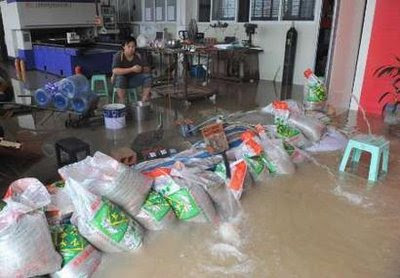
A worker sits behind a pile of sandbags as pumping units pump flood water out of a workshop after Typhoon Morakot hit Fuzhou, Fujian province August 9, 2009. A child was killed and houses were flattened after the typhoon battered China's eastern coast on Sunday, bringing torrential rain and high waves likely to disrupt life and business across the heavily commercial region. REUTERS/Kong Nong


Flood waters brought on by Typhoon Morakot submerge a house in Pingtung county in Taiwan. China rushed nearly one million people out of harm's away as Typhoon Morakot slammed into its coast after triggering Taiwan's worst flooding in 50 years, leaving at least four people dead.
(AFP/Sam Yeh)


A rescue worker carries a baby as a family is rescued from flooding brought by Typhoon Morakot in Chiatung, Pingtung county, in southern Taiwan. China rushed nearly one million people out of harm's away as Typhoon Morakot slammed into its coast after triggering Taiwan's worst flooding in 50 years, leaving at least four people dead.
(AFP/Sam Yeh)


Rescuers try to reach a man who is stranded by floods as Typhoon Morakot approaches in Shanghai August 9, 2009.
REUTERS/Stringer


Rescuers help local residents escape the flooding brought on by Typhoon Morakot in Chiatung, southern Taiwan. China rushed nearly one million people out of harm's away as Typhoon Morakot slammed into its coast after triggering Taiwan's worst flooding in 50 years, leaving at least four people dead.
(AFP/Sam Yeh)


A hotel building leans before falling in a heavily flooded river after Typhoon Morakot hit Taitung county, Taiwan, Sunday, Aug. 9, 2009. The six-story hotel collapsed and plunged into a river Sunday morning after floodwaters eroded its base, but all 300 people in the hotel were evacuated and uninjured, officials said.
(AP Photo)
READ MORE - Typhoon Morakot slams China

Cambodia: Law On The Statute Of Judges

Scoop New Zealand

Sunday, 9 August 2009

Press Release: Asian Human Rights Commission

Cambodia: Law On The Statute Of Judges, Not Their Retirement, Is The Right End From Which To Tackle Judicial Reform

Last June the Cambodian government ignored the jurisdiction of the nomination and discipline of judges and prosecutors of the Supreme Council of the Magistracy (SCM) when it bypassed the court and got the King, who is chairman of this supreme judicial council, to retire and replace half of the eight SCM members. The retired members were Ouk Vithun, Prosecutor General of the Supreme Court, 62, an ex-officio member; Henrot Raken, 68, Prosecutor General of the Appeal Court, another ex-officio member; Khieu Sameth, 62, President of Kandal Provincial Court, an appointed member; and Sin Dim, 66, President of Preah Sihanouk Provincial Court, another appointed member.

The government’s infringement upon the SMC’s jurisdiction is unconstitutional as it violated the independence of the judiciary of which the SCM is an integral part. Apparently the government was not happy with the lack of the SMC’s swift disciplinary action against a provincial prosecutor whose alleged faults had been widely reported in the press.

Perhaps more importantly, the government was not happy with the SCM when the latter had not retired the judges and prosecutors it had proposed. The SCM had its own reasons for not heeding the government’s proposal. It wanted to uphold its independence and exercise its authority over the nomination and discipline of judges and prosecutors.

Even more importantly, there was no law on the statute of judges and prosecutors which should set the retirement age for them. The government has not yet enacted this long overdue law and also the law on the organization of the judiciary when the country‘s Constitution has specifically stipulated the need to enact both laws since 1993. Like the law on the statute of civil servants and the law on the statute of members of the armed forces, which have not been specifically stipulated in the Constitution and which had both been enacted in the mid-1990s, this law on the statute of judges and prosecutors would determine, among other things, the age of retirement for judges and prosecutors. Without this law, the SCM would have no legal basis to retire judges and prosecutors.

The SCM did not comply with a government decree (not a law) which has been echoed by subsequent government circular letters and which fixes the retirement age of 60 for judges and prosecutors when this decree was based on no law on the statute of judges and prosecutors. This inaction has led the government to accuse the SCM of defending certain members of the judiciary who have wished to remain in active service.

Now with a new composition more amenable to the government’s wishes, the SCM sets out to retire some 27 elder judges and prosecutors, retirement which some have seen as part of the long overdue judicial reform.

However, the retirement of the four members of the SCM in June and the planned retirement of a big batch of judges and prosecutors are but palliatives to defuse mounting pressure for judicial reform. These measures have tackled this reform at the wrong end and have in no way come to address the real issue of the legal foundation of Cambodia’s entire judiciary. They have further violated the constitutional principle of the separation of powers, judicial independence and consolidated the executive control of the judiciary.

If the government is not happy with the functioning of the SCM, the Prime Minister should raise the issue with the King who is its chairman when he has an audience with him twice a month (Art.20 of the Constitution). The government should not delay any further the enactment of the law on the statute of judges and prosecutors and the law on the organization of the judiciary so that judges and prosecutors, who belong to the same body of magistrates, would have proper legal status, which they don’t have at the moment, and all courts of law would be duly established by law, which they are not at the moment. Everyone would thus be entitled to be tried by an independent, competent and impartial tribunal established by law, a right which is specifically stipulated under Article 14 of the International Covenant on Civil and Political Rights to which Cambodia is a party.

The government cannot apply the law on the nomination of judges and on the functioning of courts of law enacted in the communist days, prior to the promulgation of the current Constitution, and any decree enacted thereof when they are not among the “Laws and standard documents in Cambodia that safeguard State properties, rights, freedom and legal private properties and in conformity with the national interests, (which) shall continue to be effective until altered or abrogated by new texts” under the transitional article 158 of the current Constitution.

The absence of the law on the statute of judges and prosecutors poses a big problem of legitimacy for the composition of the SCM itself whose three judge members should be elected by their peers, an election which has been held up for 16 years, which is too long. The lack of the legitimacy of the composition of the SCM in turn questions the legitimacy of the composition of the country’s Constitutional Council which is a sort of a constitutional court, whose three members are appointed by the SCM.

The Asian Human Rights Commission (AHRC) urges the Cambodian government to prioritise the building of the legal foundation and framework of the country’s entire judiciary, its organization and the status of judges and prosecutors by enacting the law on their statute, including their retirement age, in tandem with the law on the organisation of the judiciary, two of the important laws that are specifically stipulated in the country’s constitution. This is the right end from which it should tackle judicial reform in Cambodia.

About AHRC: The Asian Human Rights Commission is a regional non-governmental organisation monitoring and lobbying human rights issues in Asia. The Hong Kong-based group was founded in 1984.
READ MORE - Cambodia: Law On The Statute Of Judges

Typhoon pummels China, forcing nearly 1M to flee


A resident rides a motorcycle on a flooded road as typhoon Morakot approaches in Xiapu County of Ningde, Fujian province, August 9, 2009.
REUTERS/Stringer


By GILLIAN WONG, Associated Press Writer

BEIJING – A typhoon pummeled China's eastern coast Sunday, toppling houses, flooding villages and forcing nearly a million people to flee to safety. Officials rode bicycles to distribute food to residents trapped by rising waters.

Typhoon Morakot struck after triggering the worst flooding in Taiwan 50 years, leaving dozens missing and feared dead and toppling a six-story hotel. It earlier lashed the Philippines, killing at least 21 people.

Morakot, which means "emerald" in Thai, made landfall in China's eastern Fujian province, carrying heavy rain and winds of 74 miles (119 kilometers) per hour, according the China Meteorological Administration. At least one child died after a house collapsed on him in Zhejiang province.

People stumbled with flashlights as the storm enveloped the town of Beibi in Fujian in darkness, the official Xinhua News Agency said. Strong winds uprooted trees or snapped them apart, while farmers tried to catch fish swept out of fish farms by high waves.

Village officials in Zhejiang rode bicycles to hand out drinking water and instant noodles to residents stranded by deep floods, while rescuers tried to reach eight sailors on a cargo ship blown onto a reef off Fujian, Xinhua reported.

Morakot was expected to weaken as it traveled north at about six miles (10 kilometers) per hour, but still bring strong winds and heavy rains to Shanghai, the meteorological administration said.

Flood control officials in Shanghai released water stored in inland rivers to reduce levels in preparation, Xinhua said.

About 1 million people were evacuated from China's eastern coastal provinces — more than 490,000 in Zhejiang and 505,000 in neighboring Fujian. Authorities in Fujian called 48,000 boats back to harbor.

Five houses were destroyed by heavy rain ahead of the typhoon's landfall, burying four adults and a 4-year-old boy in debris, Xinhua said. The child died after emergency treatment failed, it said.

Another 300 houses collapsed and thousands of acres (hectares) of farmland were inundated, Xinhua said.

Dozens of domestic flights were canceled and delayed in Fujian and Zhejiang, and bus service in Fujian's capital, Fuzhou, was suspended, it said.

Taiwan, meanwhile, was recovering after the storm dumped more than 80 inches (200 centimeters) of rain on some southern counties Friday and Saturday, the worst flooding to hit the area in half a century, the Central Weather Bureau reported.

Taiwan's Disaster Relief Center said a woman was killed when her vehicle plunged into a ditch in Kaohsiung county in heavy rain Friday, and two men drowned in Pingtung and Tainan. It said 31 were missing and feared dead.

Morakot hit Taiwan late Friday and crossed the island Saturday. The Disaster Relief Center reported Sunday that flash floods washed away a home in southern Kaohsiung, leaving 16 people missing. Three were swept away in southeastern Taitung county, including two policemen helping to evacuate villagers.

Twelve others were missing, including three fishermen from a capsized boat and three others whose cars fell into a rain-swollen river, it said.

In southern Pingtung county, 4,000 people were stranded in inundated villages waiting for police boats to rescue them, news media reported.

In Taitung county, a six-story hotel collapsed and plunged into a river after floodwaters eroded its base, but all 300 people inside were evacuated and uninjured, officials said.

In the northern Philippines, the typhoon and lingering monsoon rains left 21 people dead and seven others missing in landslides and floodwaters, including three European tourists who were swept away Thursday, the National Disaster Coordinating Council said Sunday.

The bodies of the Belgian and two French citizens were found Friday, the council said.

Meanwhile, Xinhua said three fishermen died and 26 others were missing from Tropical Storm Goni, which hit Guangdong on Wednesday but weakened into a tropical depression by Sunday. Helicopters and ships were searching for the missing crew.

___

Associated Press writers Annie Huang in Taipei and Jim Gomez in Manila contributed to this report.
READ MORE - Typhoon pummels China, forcing nearly 1M to flee

Cambodia to register 12th century temple as World Heritage Site

www.chinaview.cn
2009-08-09

PHNOM PENH, Aug. 9 (Xinhua) -- Cambodia will submit the application form to list 12th century Banteay Chmar temple as World Heritage Site with the heritage committee of UNESCO soon, the local media reported on Sunday.

"Listing of the temple is aiming at conservation of the heritage site and its value is humanitarian heritage," according to khmer language newspaper Kampuchea Thmey Daily.

It added that Cambodia delegation led some experts from UNESCO,and delegation from Foundation for World Heritage to visit the temple on Saturday.

The temple located in Banteay Mean Chey province, about 60 km distance in northern area of provincial town.

Cambodia has already registered Angkor Wat temple, Royal Ballet, Khmer shadow theater and Khmer temple Preah Vihear as World Heritage Sites.

Editor: Li Xianzhi
READ MORE - Cambodia to register 12th century temple as World Heritage Site

Hamill's Khmer Rouge testimony delayed

The Timaru Herald
http://www.stuff.co.nz

09/08/2009

A new date has been set for Olympic rower Rob Hamill to testify about his brother's murder by the Pol Pot regime in Cambodia has been pushed back.

Hamill was due to testify before the Khmer Rouge Tribunal on August 12, but the date was pushed back to August 18 today.

Kerry Hamill ended up at the S-21 or Tuol Sleng prison headed by Kaing Guek Eav, better known as Duch, when the yacht he and friends were sailing strayed into Cambodian waters on August 13 1978.

One crewman, Canadian Stuart Glass, was shot while Mr Hamill and Briton John Dewhirst were taken for interrogation and torture for two months before being killed.

Led by Pol Pot, who died in 1998, the Khmer Rouge emptied Cambodia's cities in the 70s in a bid to forge a communist utopia. Up to two million people died from starvation, overwork, torture or execution during the 1975-1979 regime.

- NZPA
READ MORE - Hamill's Khmer Rouge testimony delayed

Cambodian culture in Chicago


August 9

During the genocide in Cambodia that killed 1.2 million people between 1975 and 1979 thousands of Cambodians fled for their lives. Around 5,000 Cambodians currently live in Illinois and many live in the Albany Park and Uptown areas of Chicago.

The Cambodian culture is alive in Chicago through its’ music, food, dance and religion. April is the month of the Cambodian New Year which is celebrated during a three-day festival.

One place for Cambodians to celebrate and join together is the Kampuchean Buddhist Society in Chicago.
Kampuchean Buddhist Society in Chicago.

Immigrant Connect Chicago published a video entitled, Sampling Cambodian Culture in Chicago. Check out the video to see the highlights on how Cambodians maintain their culture while living in America.

Photo by: Albeiror24 / Wikimedia Commons
READ MORE - Cambodian culture in Chicago

UNC Professor Analyzes Khmer Rouge

Saturday, August 8, 2009

http://www.wchl1360.com/

By Matt Stradley
WCHL Reporter

A human rights tribunal in Cambodia is questioning several leaders from the Khmer Rouge regime almost 25 years after their rule came to an end.

Dr. Jeffrey Sonis, associate professor in the departments of Social Medicine and Family Medicine, at UNC says the trials offer a unique opportunity to gauge the psychological effect of war trials on a society.

Sonis, the lead author in a study published in the Journal of the American Medical Association, says the rate of Post Traumatic Stress Disorder, or PTSD, in Cambodians estimated at 11% of the population is five times higher than the United States.

Accounts of the genocide estimate between one and two million people were killed to create an “agrarian collectivism” a communist concept for an ideal society.

Sonis says the study showed a quandary between feelings of justice and fears of rehashing past memories.

Sonis and his colleagues are now conducting a study funded by the National Institute of Mental Health to measure the effects of the trials on Cambodians over time.
READ MORE - UNC Professor Analyzes Khmer Rouge

ASEAN commemorates 42nd anniversary with environment issue


Surin Pitsuwan, secretary general of the Association of Southeast Asian Nations (ASEAN), delivers a speech during a commemoration activity in Jarkata, Indonesia, on Aug. 8, 2009. The ASEAN on Saturday marked the 42nd anniversary of its founding with the theme of "Green Asia" to reflect its care about environment. (Xinhua/Li Xiaoyu)

www.chinaview.cn
2009-08-08

JAKARTA, Aug. 8 (Xinhua) -- The Association of Southeast Asia Nations (ASEAN) commemorated its 42nd anniversary with theme of "Green Asia" to reflect its care about environment that has been deteriorated by climate change, the association's chief said here on Saturday.

"Today, we commemorate our 42nd anniversary, to commemorate achievements of we made to our people and the world's, just what our founding fathers wanted," said Surin Pitsuwan, the association's secretary general in his opening speech.

He said that climate change has been the top agenda of many countries, governmental bodies, inter-governmental summits et cetera.

"That's why we choose the topic for our commemorations' theme today," he said.

According to Surin, ASEAN is the home for so many species of flora and fauna that do not exist in other part of the world.

"ASEAN is just 3 percent part of the Earth but we have 20 percent of plants, animals, and marine species of the world's total," Surin said, adding that ASEAN contributed so much oxygen even though it emits much carbon dioxide too.

He said that making more comfortable and more livable Earth is the world's responsibility by preserving green environment.

According to Surin, all across ASEAN and the world that have ASEAN committee is commemorating the anniversary on Saturday.

"In London, Tokyo, Beijing, Brazil, for example, they are commemorating this anniversary. In fact, I just received messages from Moscow and Washington that they are commemorating this event, even though it's still early there," he said.

ASEAN consists of countries located in the Southeast Asia region, namely Indonesia, Brunei Darussalam, Malaysia, the Philippines, Cambodia, Lao PDR, Myanmar, Singapore, Thailand and Vietnam.

According to the association's data in 2007, ASEAN has 576 million populations who lived on 4.5 million square meters. The countries have combined gross domestic product (GDP) of 1,282 trillion U.S. dollars with total trade of 1.616 trillion dollars.


Editor: Li Shuncheng
READ MORE - ASEAN commemorates 42nd anniversary with environment issue


Label

Label

Labels